This Day in Car History: Oct. 27, 1948 — The Jaguar XK120 Steals the Show
On Oct. 27, 1948, a low, swoopy roadster rolled into London's Earls Court show and made every other car look old. Here's how the Jaguar XK120 went from a quick engine showcase to the fastest production car of its day.
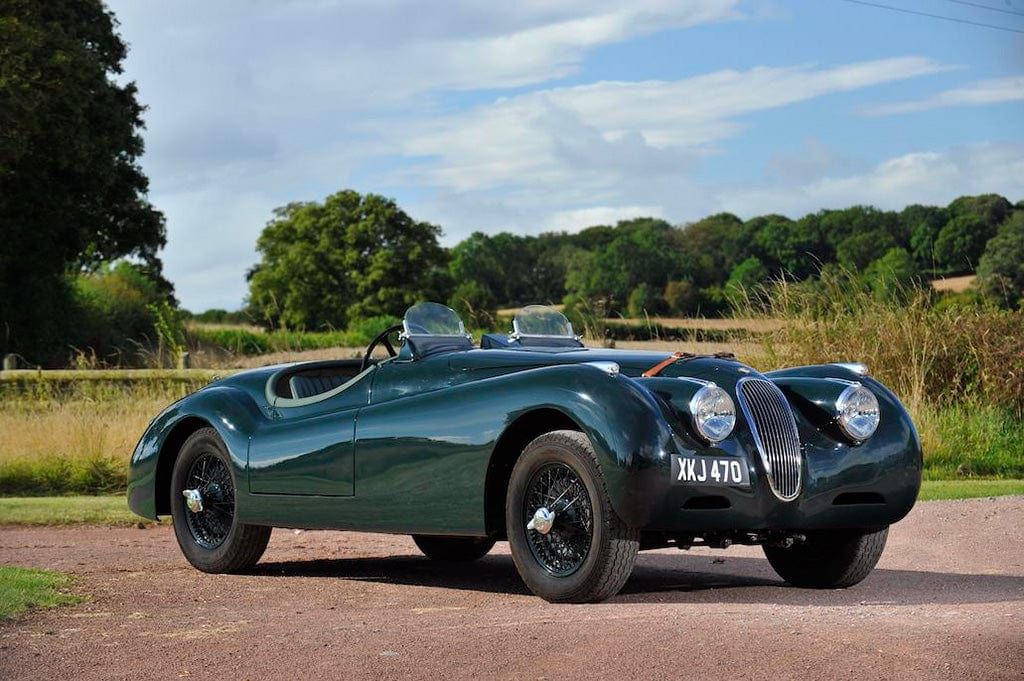
The story
Britain in 1948 was still living with wartime rationing and austerity. So when the London Motor Show opened at Earls Court on October 27, 1948, people showed up hungry for something new. More than half a million came through the doors, according to History Today. They got two headline acts: the sensible little Morris Minor, which a lot of families hoped to own, and the Jaguar XK120, which everybody wanted to stare at.
The Jaguar was almost an accident. William Lyons’ company had developed a new 3.4-liter twin-cam straight-six, called the XK engine, for a big new sedan. That sedan wasn’t ready. So Jaguar wrapped the engine in a sleek two-seat body, reportedly in about two months, and used it as a rolling showcase, per Hagerty.
The plan was a limited run of roughly 200 cars with hand-built aluminum bodies over a wooden ash frame. The reaction at Earls Court blew that plan up. Orders poured in, and Jaguar moved to pressed-steel bodies for volume production. Shannons’ club history says Lyons may have made that call on opening day itself.
The name made a promise: 120 mph. Skeptics doubted a production car could do it, so in May 1949 Jaguar flew journalists to a highway near Jabbeke, Belgium. Test driver Ron “Soapy” Sutton averaged about 132.6 mph over a flying mile with the windscreen off, and about 126 mph with the screen and top up, according to Motor Sport’s June 1949 report. The magazine called it the highest speed yet reached by a production car.
From there, the XK120 went racing and rallying, picked up a coupe in 1951 and a drophead coupe in 1953, and stayed in production until 1954.
Fun facts
- One car, one shot. Only a single finished XK120 was ready when the 1948 show opened. Jaguar was taking orders on a car it hadn’t figured out how to mass-produce yet.
- Fast and polite. At the 1949 Jabbeke run, Sutton reportedly idled past spectators at about 10 mph in top gear, just to prove the engine wasn’t a temperamental race motor.
- Built for export. About 10,400 of roughly 12,000 XK120s were left-hand drive. Of the first 142 right-hand-drive cars, only four stayed in Britain and about 70 went to Australia, per Shannons.
- Octane mattered. The standard engine made 160 hp on 80-octane fuel. UK cars got a lower 7:1 compression version because British “Pool” petrol was only about 70 octane.
- Hollywood was hooked. Clark Gable owned XK120s, including one he took delivery of while filming Never Let Me Go in Cornwall, per Hagerty. The popular claim that he got the very first customer car is disputed by XK registry researchers.
- It kept getting faster. In October 1953, Jaguar’s Norman Dewis pushed a heavily modified XK120 to a two-way average of about 172 mph at Jabbeke.
Quick facts
| Item | Detail |
|---|---|
| Debut | London Motor Show, Earls Court, opened Oct. 27, 1948 |
| Maker | Jaguar (Coventry, England) |
| Engine | 3.4-liter (3,441 cc) twin-cam straight-six, 160 hp |
| Price then | £998–£999 before purchase tax (sources differ by £1) |
| Approx. price today | About £47,000 (UK composite price index; approximate) |
| Production | About 12,000 (sources list 12,045 or 12,055) |
| Alloy-bodied cars | 242, built 1948–1950 |
| Body styles | Roadster (1948), fixed-head coupe (1951), drophead coupe (1953) |
| Production ended | 1954 |
Then vs. now
Adjusted for inflation, the XK120’s pre-tax price works out to roughly £47,000 today. That’s a ballpark figure, and it leaves out the hefty British purchase tax of the era. For context, the average new car in the U.S. sold for about $50,500 in September 2026, per Kelley Blue Book, so a world-beating sports car in 1948 cost about what a well-equipped family crossover costs today.
What you get for the money is a different story. The XK120 had no seat belts, no airbags and no crumple zones. Today’s cheapest new car would protect you far better in a crash. The XK120’s 160 hp was headline news in 1948; plenty of today’s compact SUVs make more.
Buying was different too. Early buyers had to trust that a show car would really reach production, and most cars were shipped overseas. Today, the waiting is usually at the finance desk, not the factory. If you’re shopping now, know what a car really costs to own today and how credit tiers set your rate before you go. And whether you’re buying a classic or a crossover, behave at the dealership and you’ll get a better deal.
The bottom line
The Jaguar XK120 was a side project that turned into a legend because the public saw it first and voted with their wallets. It was fast, beautiful and, for what it did, a bargain. It also shows how much cars have changed: today’s average car is safer and quicker than many 1940s dream machines. Celebrate the history, but buy your daily driver with today’s numbers in front of you.
FAQ
When did the Jaguar XK120 debut?
The Jaguar XK120 made its public debut at the London Motor Show at Earls Court, which opened on October 27, 1948. Only one finished car was ready for opening day. Jaguar planned a short run of about 200 cars, but demand pushed it into full production that lasted until 1954.
Why is it called the XK120?
“XK” was the name of Jaguar’s new twin-cam six-cylinder engine, and “120” pointed to the car’s roughly 120 mph top speed. In May 1949, a near-stock car proved it on a Belgian highway, averaging about 132.6 mph with the windscreen removed and about 126 mph with it in place.
How much did a Jaguar XK120 cost new?
Sources list the launch price at £998 or £999 before British purchase tax, which is roughly £47,000 in today’s money by one inflation estimate. Taxes added a lot: a 1949 magazine test car cost £1,263 with tax included. Most XK120s were built in left-hand drive for export markets.
History facts checked against the sources below as of Oct. 27, 2026. Inflation figures are approximate.
Comments
No comments yet.
Sign in with Google to comment